The Silent Partner of Earth
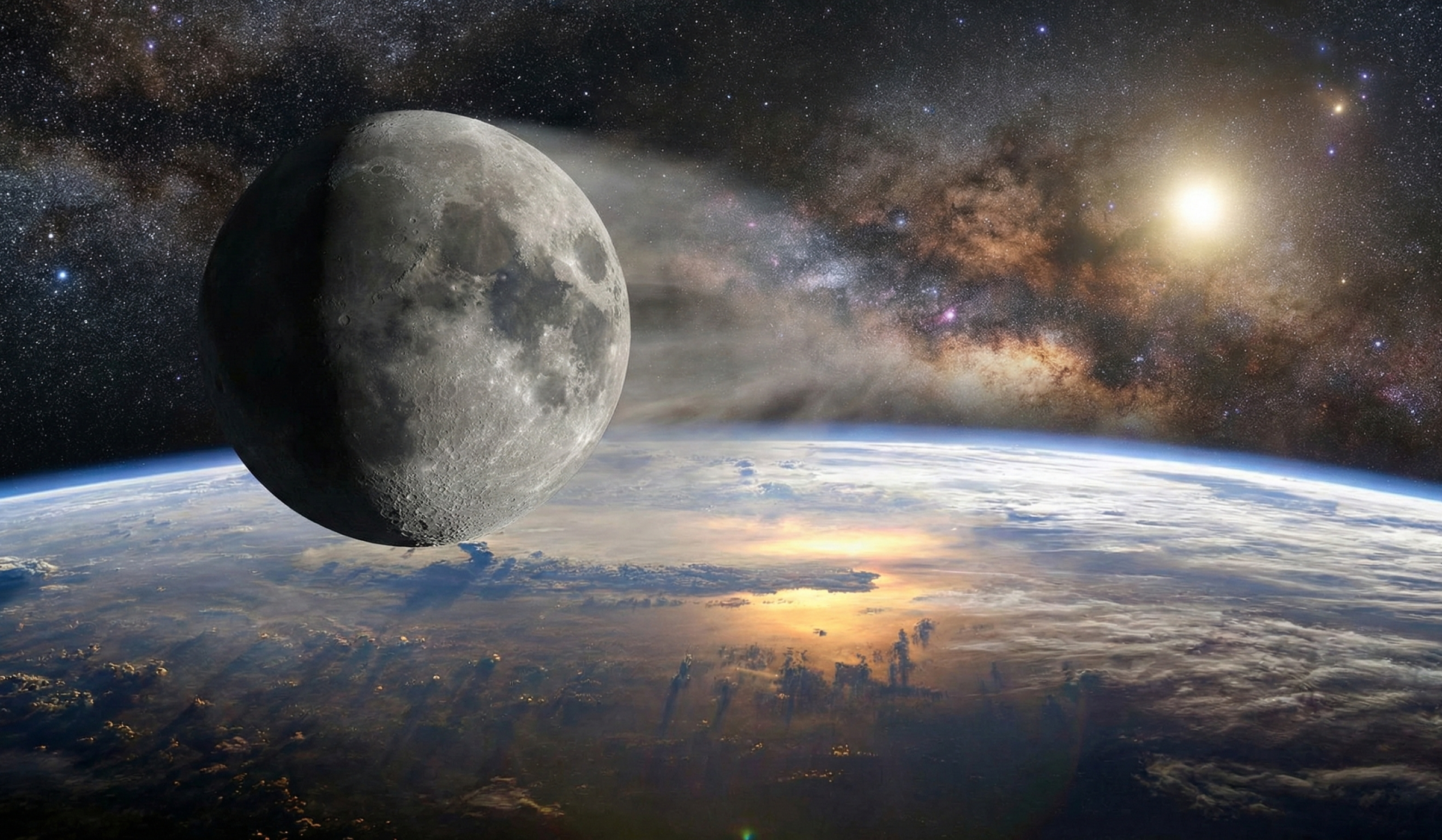
For billions of years the Moon has been Earth’s constant companion, orbiting at an average distance of about 384,000 kilometers. Although it often appears as nothing more than a bright disk in the night sky, the Moon plays a profound role in shaping the physical conditions of our planet. Its gravity influences oceans, stabilizes Earth’s rotation, and subtly controls the rhythm of many biological systems.
The Earth–Moon system formed roughly 4.5 billion years ago, most likely after a massive collision between the early Earth and a Mars-sized object called Theia. Debris from this impact eventually coalesced to form the Moon. Since then, the gravitational relationship between Earth and the Moon has become one of the most important factors influencing the planet’s long-term stability.
Imagining Earth without the Moon reveals how deeply this satellite affects the environment and evolution of life.
The Collapse of Ocean Tides
One of the most immediate consequences of the Moon disappearing would involve Earth’s oceans. The gravitational pull of the Moon is the primary force that generates tides across the planet. As the Moon orbits Earth, its gravity pulls on the oceans, creating bulges of water that result in high and low tides along coastlines.
Without the Moon, tides would not vanish completely, but they would become dramatically weaker. The Sun also produces tides through its gravity, yet solar tides are much smaller than lunar tides. In the absence of the Moon, tides would shrink to roughly one third of their current strength.
This change would have major consequences for marine ecosystems. Many coastal organisms rely on tidal cycles for feeding, reproduction, and migration. Tidal wetlands, estuaries, and mangrove forests depend on the regular movement of water to circulate nutrients and oxygen. Weak tides would disrupt these systems and could alter coastal biodiversity on a global scale.
Ocean circulation patterns might also change over long timescales, potentially influencing climate systems that depend on the mixing of ocean layers.
A Darker Night on Earth
Another noticeable change would occur in the brightness of the night sky. The Moon reflects sunlight toward Earth and is by far the brightest object in the night sky after the Sun. During a full Moon, landscapes can be illuminated well enough for humans to navigate without artificial light.
If the Moon disappeared, nights would become significantly darker. Starlight alone provides only a tiny fraction of the illumination that moonlight offers. The Milky Way would appear more visible, but the overall brightness of the night environment would drop dramatically.
This darker world would influence many nocturnal animals. Numerous species depend on lunar brightness to guide hunting, mating, or migration. Some predators use moonlit nights to spot prey, while other animals hide during bright lunar phases to avoid detection. The removal of this natural light cycle could disrupt the behavior of many ecosystems.
Human cultures would also lose phenomena such as lunar eclipses, lunar calendars, and the familiar monthly phases of the Moon that have influenced societies for thousands of years.
The Instability of Earth’s Axis
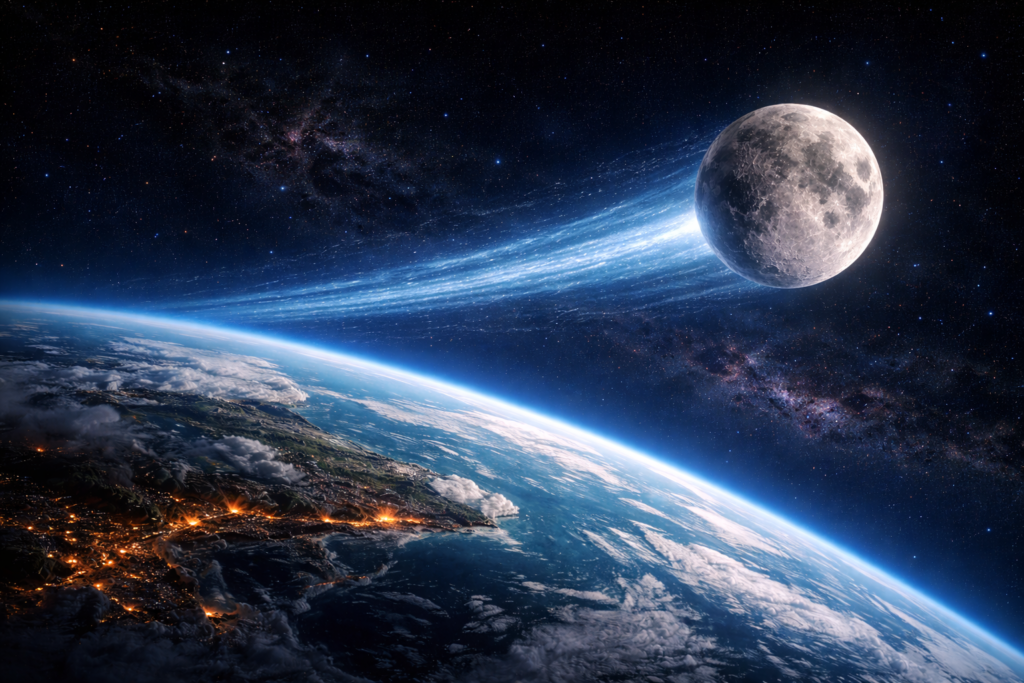
Perhaps the most significant long-term impact of losing the Moon involves Earth’s axial tilt. The axis of Earth is tilted about 23.5 degrees relative to its orbit around the Sun. This tilt is responsible for the seasons experienced across the planet.
The Moon acts as a gravitational stabilizer that helps maintain this tilt within a relatively narrow range. Its presence prevents large fluctuations in the orientation of Earth’s axis over geological timescales.
Without the Moon, computer simulations suggest that Earth’s tilt could become unstable. Over millions of years the axial tilt might vary dramatically, possibly shifting between nearly zero degrees and more than sixty degrees.
Such changes would have profound consequences for global climate. When the tilt becomes very small, seasons would weaken and many regions might experience relatively constant weather patterns. When the tilt grows extreme, seasonal contrasts would intensify. Summers could become extremely hot in some regions while winters become intensely cold in others.
These fluctuations could trigger repeated climate upheavals and drastically reshape the distribution of ecosystems across the planet.
Changes in Earth’s Rotation
The Moon also influences how fast Earth rotates. Through a process called tidal friction, the gravitational interaction between Earth and the Moon gradually slows Earth’s rotation over time. As ocean tides move across the planet, friction between water and the seafloor transfers energy and slowly reduces Earth’s spin.
Because of this process, Earth’s rotation has been slowing for billions of years. In the distant past, a single day on Earth lasted far fewer hours than it does today. Geological evidence suggests that during the age of the dinosaurs, days were slightly shorter than the modern twenty-four hour cycle.
If the Moon suddenly disappeared, the tidal braking effect would largely stop. Earth would continue rotating at roughly its current speed, with only small influences from the Sun and atmospheric forces.
Over very long timescales this could slightly alter the length of a day compared with what it would have been if the Moon had remained present.
A Catastrophic Scenario of Lunar Destruction
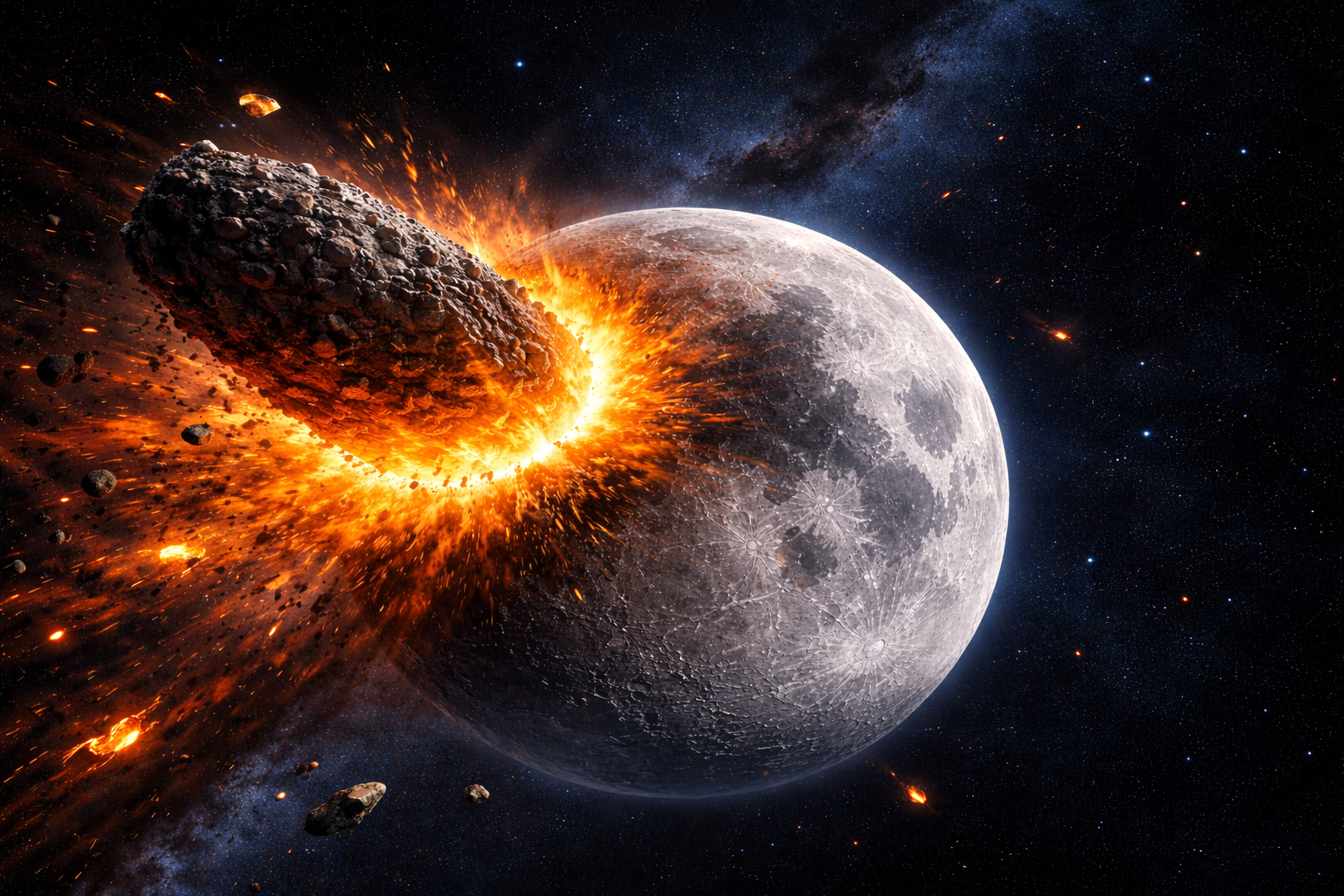
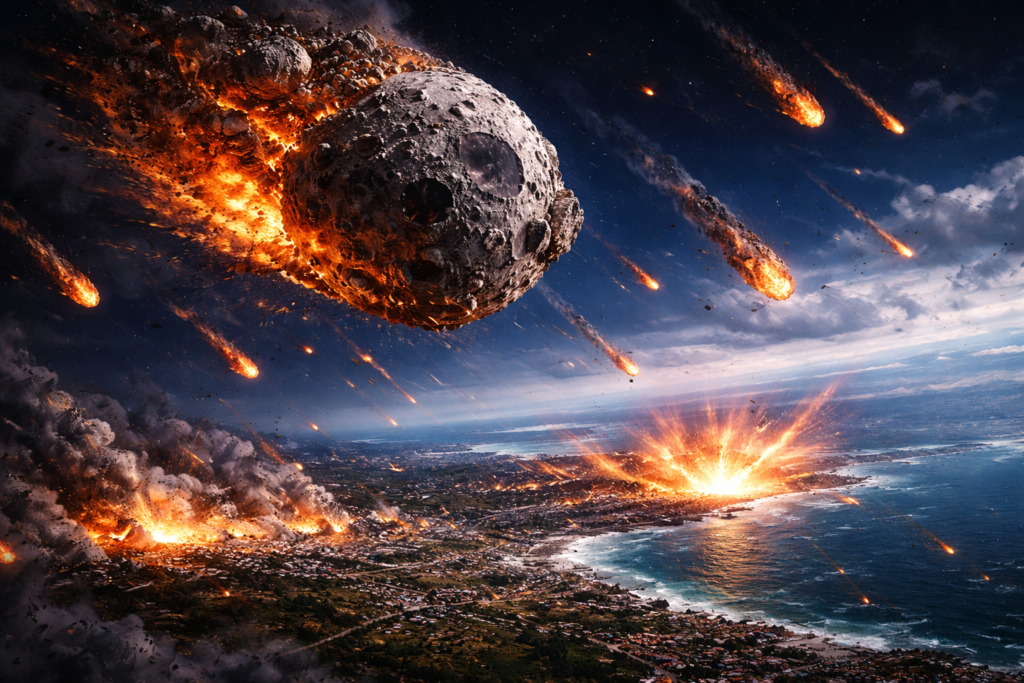
A different scenario involves the Moon not simply disappearing but being shattered by a massive impact. Although extremely unlikely, a collision with a very large asteroid could theoretically break the Moon apart.
In such a case, the debris might form a ring system around Earth similar to the rings of Saturn. Over time, gravitational interactions would cause many fragments to fall toward Earth.
These falling fragments could produce long periods of intense meteor activity. Smaller pieces would burn up in the atmosphere, creating spectacular meteor showers, while larger fragments might reach the surface as meteorites.
Depending on the size and frequency of these impacts, Earth’s environment could experience repeated disturbances from atmospheric heating and regional impact events.